Best Language for MCP Server: TypeScript, Python, Go, or Java?#
So you're building an MCP server. Cool. Now the fun part: picking a language.
Look, I've seen teams waste months on this decision. I've also seen teams pick wrong and rewrite everything six months later. One startup literally maintained two implementations because their Python server couldn't handle OAuth. Don't be that team.
I dug through all 7 official SDKs, talked to folks running MCP in production, and put together what I wish someone told me when we started. No BS, just what actually matters.
TL;DR: Just Tell Me What to Use#
Skip the analysis, give me the answer:
| Your Situation | Best Choice | Why |
|---|---|---|
| Prototyping / solo dev | Python + FastMCP | Fastest to working server |
| Production web service | TypeScript | Best type safety, ecosystem |
| High-performance / microservices | Go | Best latency, lowest memory |
| Enterprise / Java shop | Java + Spring AI | Native Spring Boot integration |
| Systems programming | Rust | Maximum performance, safety |
| .NET ecosystem | C# | Microsoft-backed, maturing |
| PHP legacy app | PHP | Works, but limited features |
Here's the thing though: what your team already knows beats any benchmark. A Python team ships faster in Python than learning Go for marginal gains.
The honest framework:
Default to TypeScript unless:
- Your team is Python-native → Python
- You need maximum performance → Go
- You're in an enterprise Java shop → Java
The 2026 MCP SDK Landscape#
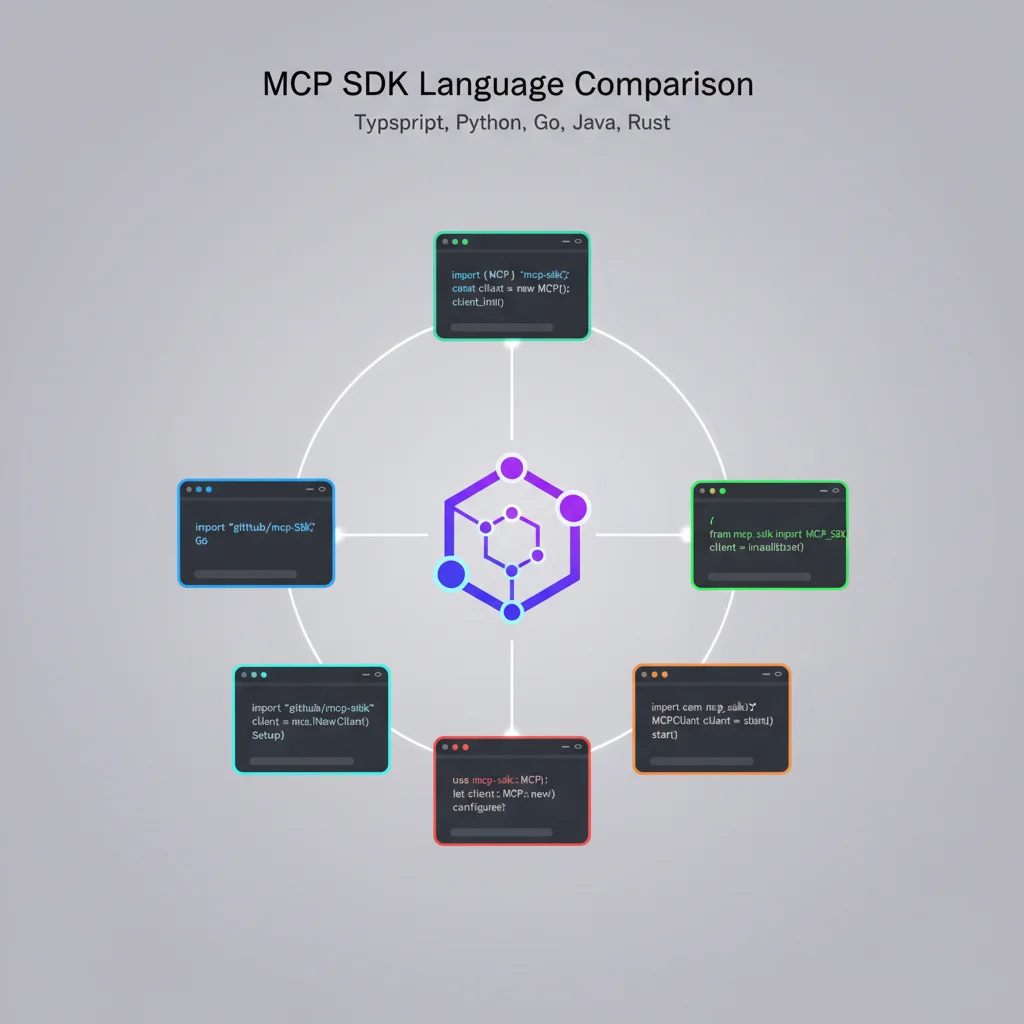
Every major language has an official SDK now. Here's what we're working with:
| SDK | Version | Status | Partner | Protocol Version |
|---|---|---|---|---|
| TypeScript | 1.28.0 | Stable | Anthropic | 2025-11-25 |
| Python | 1.26.0 | Stable | Anthropic | 2025-11-25 |
| Go | 1.4.1 | Production | 2025-11-25 | |
| Java | 1.1.0 | Stable | Spring AI | 2025-11-25 |
| Rust | 1.3.0 | Stable | Community | 2025-11-25 |
| C# | 1.1.0 | Stable | Microsoft | 2025-11-25 |
| Kotlin | 0.9.0 | Stable | JetBrains | 2025-11-25 |
| PHP | 0.4.0 | Early | PHP Foundation | 2025-11-25 |
| Swift | 0.12.0 | Stable | Apple/Community | 2025-11-25 |
| Ruby | 0.9.1 | Stable | Community | 2025-11-25 |
What this tells us: TypeScript and Python are still "Tier 1" with the most mature ecosystems. Go reached v1.4.1 by early 2026 and is fully production-ready. Java and Kotlin got serious enterprise backing from Spring AI and JetBrains. Swift and Ruby joined the ecosystem with stable SDKs.
5 Questions Before You Pick#
Forget comparing syntax for a second. Answer these first:
1. What Does Your Team Actually Know?#
This matters more than anything else. Seriously. Picking an unfamiliar language adds 2-4 weeks to any project. Not from MCP stuff, from the ecosystem learning curve.
| Team Expertise | Recommended SDK |
|---|---|
| Node.js / Frontend | TypeScript |
| Data science / ML | Python |
| Backend microservices | Go or Java |
| Enterprise / .NET | C# |
| Systems / embedded | Rust |
A real story: One team started with Python (FastMCP) for speed, then rewrote everything in TypeScript for OAuth. Their post-mortem: "We should've used TypeScript from day one. Our entire stack was Node.js anyway."
Ouch.
2. Where's This Thing Running?#
Different languages shine in different environments:
- Serverless (Lambda, Cloud Functions): Go crushes cold starts (50-100ms vs 300-500ms for Python/Java)
- Containers (K8s, Docker): Everything works fine; Go has the smallest image size
- Edge (Cloudflare Workers, Deno Deploy): TypeScript is native, Go compiles to WASM
- On-prem: Java still rules enterprise installations
3. Do You Actually Need Performance?#
Be honest with yourself here. Most MCP servers just wait around for APIs and databases to respond. Language speed almost never matters.
When performance actually matters:
- Processing large datasets in-memory
- High-frequency trading or real-time systems
- Edge deployments with strict latency budgets
- Handling 1000+ concurrent connections
Here's how it really breaks down:
| Tier | Languages | Typical Latency | Use Case |
|---|---|---|---|
| Ultra-fast | Go, Rust | 1-5ms | High-frequency, edge |
| Fast | TypeScript, Java | 5-20ms | Production APIs |
| Good enough | Python, PHP | 20-100ms | Internal tools, prototypes |
4. How Much Do You Care About Types?#
Your MCP server gets random JSON from AI clients. Strong typing catches the dumb mistakes before they hit production:
| Type Safety | Languages | What It Catches |
|---|---|---|
| Compile-time | TypeScript, Rust, Go, Java | Most errors before you deploy |
| Runtime | Python (Pydantic), PHP | Errors on first call |
| YOLO | Plain Python, JS | Errors in production at 3am |
Real example: TypeScript with Zod caught a type mismatch when Claude passed a number instead of a string. In Python, this would've silently corrupted data. Fun times.
5. How Fast Do You Need This?#
- Need it yesterday: Python + FastMCP (seriously, you can have something running today)
- Next sprint: TypeScript
- Next quarter: Go or Java (if you actually need what they offer)
The Money Part: What Devs Cost#
Technical decisions are cute, but hiring realities pay the bills. Here's what 2026 looks like:
What You'll Pay (Freelance/Contract, 2026)#
| Language | Junior | Mid-Level | Senior | AI/ML Premium |
|---|---|---|---|---|
| TypeScript | $40-60 | $60-90 | $90-115 | — |
| Python | $50-70 | $70-100 | $100-130 | $130-180 |
| Go | $50-75 | $75-110 | $110-140 | — |
| Java | $50-70 | $70-100 | $100-140 | — |
| Rust | $80-100 | $100-150 | $150-200+ | — |
Rust devs command a 50-80% premium because there just aren't many of them. Python AI/ML people are the priciest overall. TypeScript gives you the best bang for buck on web-focused MCP servers.
Good Luck Finding People#
| Language | How Bad's the Shortage | Avg Days to Hire | Trend |
|---|---|---|---|
| Python | Severe (AI ate them all) | 72 days | Getting worse |
| TypeScript | High | 68 days | Stable |
| Java | Moderate | 60 days | Stable |
| Go | High (niche) | 55 days | Growing |
| Rust | Critical | 80+ days | Very tight |
There's a ~4 million developer gap globally right now. Python leads the shortage because everyone wants AI/ML people. Rust has the smallest talent pool but fastest-growing demand. Good luck with that.
What this means for you:
- Building a team? TypeScript or Java give you the best hiring odds
- Solo or small team? Python's productivity makes up for higher rates
- Need performance? Budget 2-3x timeline to find quality Go/Rust devs
MCP Libraries: What's Actually Ready#
Not all SDKs are created equal. Here's what you can actually use in production:
Python Ecosystem#
| Library | Stars | Status | Best For |
|---|---|---|---|
| FastMCP | 21,000+ | Production | High-level, decorator-based servers |
| Official SDK | 20,700+ | Stable | Maximum control, custom transports |
These two are neck-and-neck. FastMCP is what most people use because decorators are nice and it handles auth (OAuth, JWT), composition, and deployment for you. Official SDK is for when you need to do something weird with transports.
Use the Official SDK if you're embedding MCP in an existing framework or need control over every protocol detail.
TypeScript Ecosystem#
| Library | Stars | Status | Best For |
|---|---|---|---|
| Official SDK | 11,000+ | Stable | Production servers, full protocol support |
| TypeScript FastMCP | 2,800+ | Stable | FastMCP-style DX in TypeScript |
Official SDK is what you probably want. Anthropic maintains it, docs are solid. TypeScript FastMCP (by punkpeye) brings Python FastMCP's decorator patterns if you prefer that style.
Go Ecosystem#
| Library | Stars | Status | Best For |
|---|---|---|---|
| mcp-go (mark3labs) | 7,800+ | Production | Most popular, battle-tested |
| Official SDK | 3,400+ | 1.0.0 | Google-backed, full protocol |
Here's an interesting one: mark3labs/mcp-go actually has 2x more stars than the official SDK (8,445 vs 4,232). It's been battle-tested and the community loves it. The Official SDK hit 1.0.0 in late 2025 and reached v1.4.1 by early 2026 with Google's help. Go official if you need OAuth extensions or want that Google backing.
Java Ecosystem#
| Library | Stars | Status | Best For |
|---|---|---|---|
| Official SDK | 3,000+ | Stable | Direct MCP implementation |
| Spring AI MCP | 200+ | Experimental | Spring Boot integration |
Official SDK for most Java shops. Spring AI MCP is nice if you're already on Spring Boot because auto-configuration. Still experimental though, so YMMV.
Rust Ecosystem#
| Library | Stars | Status | Best For |
|---|---|---|---|
| Official SDK | 2,700+ | Stable | Async/tokio-based servers |
| rust-mcp-sdk | 130+ | Active | Alternative implementation |
Official SDK is the only real choice for Rust. Tokio-based, async-first, well-maintained. There are community alternatives, but nobody uses them.
C# / .NET Ecosystem#
| Library | Stars | Status | Best For |
|---|---|---|---|
| Official SDK | 3,700+ | Preview | Microsoft-backed, .NET apps |
Microsoft's involved with this one. Still in preview (0.5.0), but it's the 3rd most-starred official SDK after Python and TypeScript. Solid momentum.
Quick Cheat Sheet#
| What You Need | Python | TypeScript | Go | Java |
|---|---|---|---|---|
| Ship fast | FastMCP | Official SDK | mark3labs/mcp-go | Official SDK |
| Control everything | Official SDK | Official SDK | Official SDK | Official SDK |
| Enterprise auth | FastMCP | Official SDK | Official SDK | Spring AI |
| Community help | FastMCP | Official SDK | mark3labs/mcp-go | Official SDK |
Don't want to deal with any of this? MCPize supports Python, TypeScript, Go, and Java out of the box. Generate boilerplate, deploy with one command, start making money. We handle hosting, billing, distribution.
Deploy Your MCP ServerLanguage Deep Dives#
Python + FastMCP: When You Need It Yesterday#
Use Python when: You need to ship fast, your team knows Python, or you're doing anything with data/ML.
FastMCP 2.0 killed the boilerplate problem. Here's a working server in 8 lines:
from fastmcp import FastMCP

mcp = FastMCP("Calculator")

@mcp.tool
def add(a: int, b: int) -> int:
    """Add two numbers."""
    return a + b
What Python nails:
- Fastest path from idea to working server
- Decorators that just work (automatic schema from type hints)
- All the data science stuff (pandas, numpy, sklearn) right there
- Pydantic validation built in
Where it gets annoying:
- Async/await can be weird if you're used to Node.js
- Type checking is optional (requires discipline or it'll bite you)
- Bigger deployment size than Go
- Slower cold starts in serverless
Here's the thing: Major AI companies run Python MCP servers in production. The language is never the bottleneck. Your external API calls are.
Python MCP TutorialTypeScript: The Safe Bet#
Use TypeScript when: You're building something that needs to last, your team already knows Node.js, or you can't afford type errors in prod.
TypeScript catches entire categories of bugs before you even run the code:
import { z } from "zod";

const SearchSchema = z.object({
  query: z.string().min(1).max(500),
  limit: z.number().int().positive().default(10),
});

// Type errors caught BEFORE deployment
What TypeScript nails:
- Compile-time type checking (errors before deployment, not at 3am)
- IDE autocomplete that actually works
- npm has everything
- OAuth libraries that aren't broken
- Long-term maintenance is way easier
What's annoying:
- More verbose than Python (just is)
- Node.js module system is a mess
- Needs a build step
Real story: One team switched from Python to TypeScript just for OAuth handling. TypeScript's async model and type system made complex auth flows actually manageable.
TypeScript MCP TutorialGo: When Speed Actually Matters#
Use Go when: You actually need that low latency, want tiny binaries, or have serious concurrency requirements.
Go hit MCP SDK v1.0.0 in late 2025 and reached v1.4.1 by early 2026, with Google helping out:
package main

import (
    "github.com/modelcontextprotocol/go-sdk/mcp"
)

func main() {
    server := mcp.NewServer("calculator")
    server.AddTool("add", addHandler)
    server.Serve()
}
What Go nails:
- 50-100ms cold starts (vs 300-500ms for Python)
- Deploy a single binary with no dependencies
- Goroutines handle concurrency beautifully
- Smallest memory footprint of the bunch
- It's just fast
What's annoying:
if err != nileverywhere- Less expressive than Python (you'll write more code)
- Smaller MCP community for now
- Generics still feel new
When to actually pick Go: High-frequency servers, edge deployments, or anywhere cold start matters. If you're not sure whether you need Go's performance, you probably don't.
Java + Spring AI: For the Enterprise Crowd#
Use Java when: Your company runs on Java, you need Spring Boot integration, or compliance requires it.
Spring AI gives you first-class MCP support:
@McpTool
public String search(@Param("query") String query) {
    return searchService.execute(query);
}
What Java nails:
- Spring Boot auto-configuration is nice
- Enterprise ecosystem (security, monitoring, all that stuff)
- Strong typing and great IDE support
- Deployment patterns your ops team already knows
- JVM tuning if you need more performance
What's annoying:
- Verbose. Very verbose. Compared to Python/TypeScript it's like 3x the code
- JVM warmup means slower cold starts
- Fat deployment footprint
- More boilerplate for MCP patterns
Honest take: If your company standardizes on Java, just use Java. Don't fight corporate. The SDK works, Spring AI integration is solid.
Everything Else: Quick Rundown#
Rust: When you need sub-millisecond latency and memory safety. SDK at v1.3.0, stable. Only pick this if you really need it.
C# / .NET: Microsoft's backing this one. Now at v1.1.0 and stable. Ready for production .NET workloads.
Kotlin: JetBrains is behind it, multiplatform support. Good if you're building Android/iOS clients that also need server stuff.
PHP: Look, there's an official SDK from PHP Foundation. It's at v0.4.0. Only use this if you're extending an existing PHP app and have no choice.
Swift: Apple and the community now maintain a stable SDK at v0.12.0. Great if you're building iOS/macOS integrations.
Ruby: Community-maintained SDK at v0.9.1, stable. Good option if your stack is Rails-based.
When One Language Isn't Enough#
Sometimes you need multiple languages. Here's what people actually do:
TypeScript Frontend + Python Backend#
┌─────────────────┐      ┌──────────────────┐
│  TypeScript     │──────│  Python Worker   │
│  MCP Server     │ HTTP │  (ML processing) │
│  (handles MCP)  │──────│                  │
└─────────────────┘      └──────────────────┘
Common pattern: TypeScript handles the MCP stuff (strong typing, OAuth), Python does the ML/data processing. Best of both worlds.
Go Gateway + Whatever Backend#
┌─────────────────┐
│  Go MCP Gateway │
│  (routing/auth) │
└────────┬────────┘
    ┌────┴────┐
    ▼         ▼
┌───────┐ ┌───────┐
│ Python│ │ Java  │
│ ML    │ │ Legacy│
└───────┘ └───────┘
Go handles the fast path (routing, auth, cold starts), then fans out to whatever backends you have. Works well when you have diverse services.
FAQ#
Should I rewrite my existing server in a different language?#
Only if you're actually hitting problems: type errors in production, can't meet performance requirements, or maintenance is killing you. "It would be faster in Go" is not a reason to rewrite.
Which SDK has the best docs?#
TypeScript and Python have the most examples and community content. Go docs are excellent but newer. Java has solid docs through Spring AI.
Can I use multiple languages in one MCP server?#
Nope. One server = one process. But you can run multiple MCP servers in different languages, or use hybrid architectures with HTTP/gRPC between components.
Is there a benchmark comparing SDKs?#
No official benchmarks. And honestly? I/O latency (API calls, database queries) dominates everything. Language choice affects cold start and memory, not request latency.
What about Ruby, Swift, or other languages?#
Both Ruby (v0.9.1) and Swift (v0.12.0) now have stable SDKs. For languages without SDKs, MCP is just JSON-RPC 2.0 — you can implement it yourself. But without an SDK, you're maintaining protocol compliance on your own. That's a lot of work. I wouldn't.
Which language do most production servers use?#
Python and TypeScript by far. The official MCP servers repo is almost entirely those two.
Okay But What Should I Actually Pick?#
Here's my honest framework:
Default to TypeScript unless:
- Your team is Python-native → use Python
- You actually need performance → use Go
- Your company runs on Java → use Java
That's it. Don't overthink this.
A working MCP server in a "suboptimal" language beats a perfect architecture that never ships. The MCP protocol doesn't care what language you use. Pick what your team knows, ship fast, optimize later if you need to.
Now Go Build Something#
Pick your language, read the tutorial, ship it:
Python + FastMCP Guide TypeScript + Zod Guide Browse Existing ServersMore reading:
- Build MCP Server: Complete Guide — Language-agnostic fundamentals
- MCP Tutorial — Hands-on beginner guide
- What is MCP? — Protocol basics
Building in Go, Java, or Rust? We'd love to hear about it. Drop by the MCPize Discord and share what you're working on.